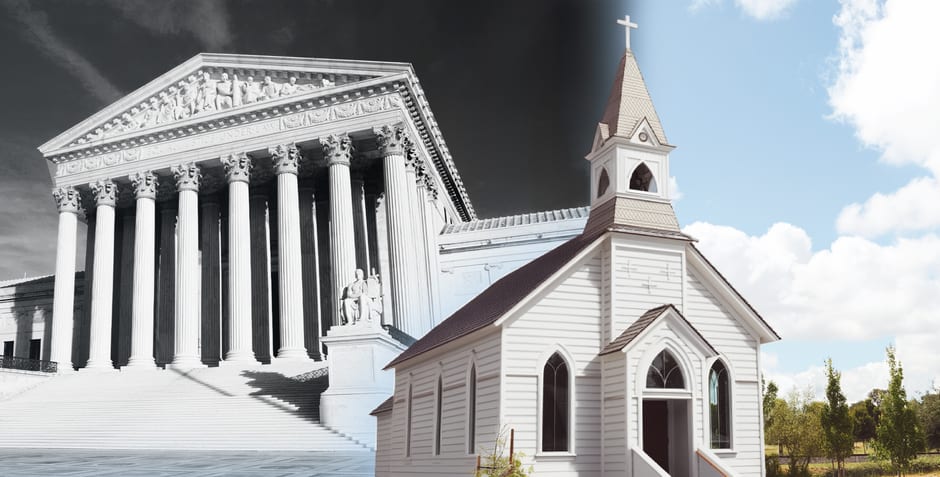
Is Banning a Church From Building on Its Property’s Just “A Mere Inconvenience”? The Supreme Court Will Decide
Listen tothis article
The Supreme Court just agreed to take up a case that could reshape how every church in America is treated when it tries to build. Last week, the Court granted certiorari in Missionaries of Saint John the Baptist v. Frederic to define what counts as a “substantial burden” on religious exercise under the Religious Land Use and Institutionalized Persons Act (RLUIPA).
A Catholic religious organization in Park Hills, Kentucky, wanted to build a small chapel on land next to its church. The construction would be about the size of a backyard swimming pool. The city’s board approved the permit, but neighbors sued, and the Kentucky Supreme Court ruled against the church.
The court’s reasoning was alarming. It said that being barred from building a chapel was “a mere inconvenience” because the church could build a smaller one somewhere else. It also called the burden self-imposed because the church knew about the ordinance before it applied.
Under that logic, a complete ban on a religious use of your own property isn’t a substantial burden as long as a judge thinks you could worship some other way. Judges, not believers, would decide what matters to the faith.
The ACLJ filed an amicus brief urging the U.S. Supreme Court to take this case. We told the Justices that lower courts have been eroding RLUIPA’s protections by adding qualifiers Congress never wrote. Congress passed this law to stop local governments from treating churches as second-class property owners, and it told courts to read the statute in favor of broad protection of religious exercise.
The grant confirms that RLUIPA’s land-use protections have gone too long without guidance from the Supreme Court. Now that the Court has taken the case, the ACLJ will file an amicus brief on the merits, standing with houses of worship across the country as the Justices decide this question.
The case will now be briefed and argued. We’ve seen the same playbook in many forms, from pandemic-era restrictions to zoning ordinances. The weapon changes, but the message to churches is always the same: You get less.
This is far from our first fight over RLUIPA. Just last month, we filed a merits-stage amicus brief in Grand v. City of University Heights, where the Supreme Court is now reviewing the case of an Orthodox Jewish man who was subjected to a punishing zoning process just to host a prayer gathering in his home. We had first urged the Court to take that case in a cert-stage brief, and we argued that RLUIPA protects people when the government uses the zoning process itself as a weapon.
But we haven’t only written briefs. We’ve gone to bat for believers on the ground, including in Fairfax County, Virginia, where officials proposed crippling home Bible studies, in Georgia, where a retired couple was told their home ministry violated zoning law, and in Manhattan Beach, California, where a resident could host 100 people to watch a movie but not to gather for worship.
In each case, RLUIPA was the shield, and the government backed down.
Join us at the Supreme Court. Sign our petition – Defeat the Left’s War Against Christians.