ACLJ Files Amicus Brief Defending President Trump’s Sanctions Against Anti-Israel UN Official
Listen tothis article
The International Criminal Court (ICC) has never had the authority to prosecute America’s allies. It certainly doesn’t have the authority to issue arrest warrants against the sitting Prime Minister of Israel – and yet it did. Now a federal court in Washington, D.C., is being asked to strip the President of the tools he needs to push back against the ICC. The ACLJ has just filed a critical amicus brief to make sure that doesn’t happen.
This fight didn’t start today. We have been battling the ICC’s illegitimate overreach for years, fighting to protect Israel’s right to self-defense and to ensure that American foreign policy – not foreign judges – determine how the United States responds to international threats. We fought back when the ICC first went after Israel. We fought when the Biden Administration stood by and did nothing. And we’re fighting now.
When President Trump issued Executive Order 14203, he took direct aim at those enabling the ICC’s unlawful prosecution of Israeli Prime Minister Netanyahu – including U.N. Special Rapporteur Francesca Albanese, who has now been designated as a Specially Designated National (SDN) under the International Emergency Economic Powers Act (IEEPA). We supported that Executive order from the start because the ICC’s targeting of a sitting ally’s head of government is precisely the kind of “unusual and extraordinary threat” to American foreign policy that the IEEPA was designed to address.
Take action with the ACLJ. Add our name to the petition: Let Trump Defend America.
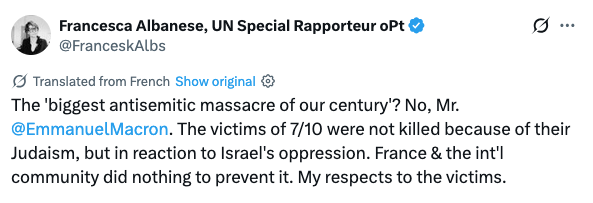
We’ve previously highlighted how Albanese, who is the U.N. Special Rapporteur on the occupied Palestinian territories (a U.N. position specifically created to wage lawfare on Israel), has blamed Israel for the Oct. 7 terrorist attacks. She attacked French President Macron for calling the devastating Hamas terror attack an “antisemitic massacre,” proclaiming: “The ‘greatest antisemitic massacre of our century’? No, Mr. @EmmanuelMacron. The victims of 7/10 were not killed because of their Judaism, but in response to Israel’s oppression. . . .”
Now, Albanese’s husband and daughter have gone to federal court seeking to remove the entire sanctions framework – not just to obtain targeted relief for their own claimed family hardships, but to effectively invalidate the Secretary of State’s foreign policy determination and enjoin the President’s Executive order altogether. That is not how our constitutional system works, and our brief explains exactly why.
The legal arguments are straightforward but essential. First, plaintiffs cannot use a family member’s designation as a backdoor to win relief that the designated person herself – Albanese — chose not to seek. The Supreme Court’s ruling in Department of State v. Muñoz makes this clear: Downstream family effects don’t give third parties the constitutional right to challenge the underlying government action. Second, even if some narrow relief were warranted, the Supreme Court’s landmark decision in Trump v. CASA, Inc., where the Court rejected universal injunctions and the ACLJ filed an amicus, prohibits courts from issuing injunctions broader than necessary to remedy the named plaintiffs’ own injuries. Invalidating the entire designation of Albanese to address a parenting license dispute is like demolishing a house to fix a leaky faucet.
Third – and perhaps most importantly – the President’s authority in foreign affairs is at its zenith when he acts to protect American allies from illegitimate international legal processes. Courts are not equipped to second-guess a President’s determination that the ICC’s prosecution of our closest ally constitutes an extraordinary national security threat.
The bottom line: Courts should not become vehicles for dismantling the President’s foreign policy tools at the behest of family members of a sanctioned foreign national who is actively working against an American ally. If a federal court can be used to unwind presidential sanctions against those enabling the ICC’s assault on Israel, no executive foreign policy tool is safe. That’s why the ACLJ is taking action in this case.